
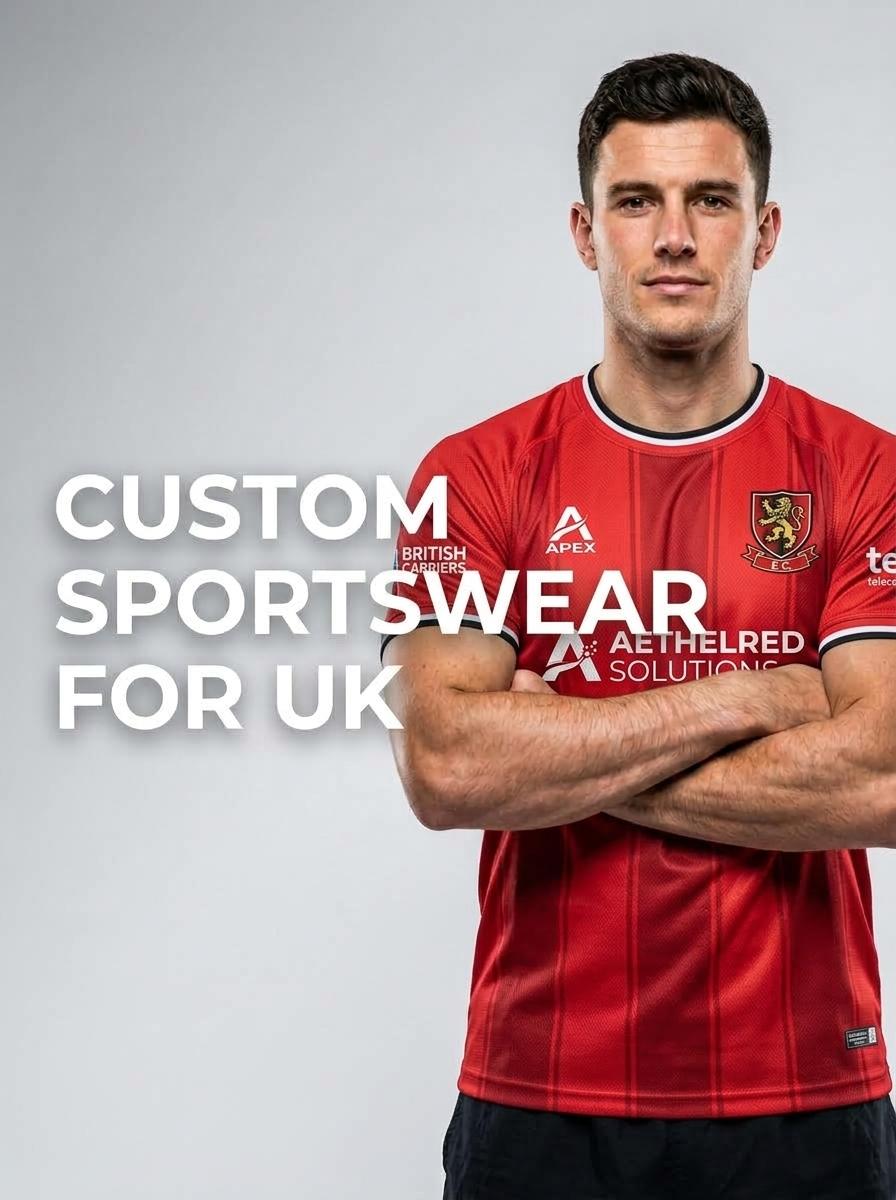
If you’re searching for custom sportswear in the UK, you’ve probably already found two very different kinds of supplier: the local printer who can turn round a dozen shirts by Friday, and the factory-direct manufacturer who builds your kit from the fabric up. Both have their place, but they solve different problems — and picking the wrong one usually means paying too much, waiting too long, or ending up with a kit that doesn’t quite match what you pictured.
This guide walks through what actually drives price and lead time, how UK import duty and VAT work when your kit is made overseas, how to choose between a printer, a stock teamwear catalogue and a full custom manufacturer, and what to check before you commit to an order — whether you’re kitting out a Sunday league side, a school PE department, or launching your own gym-wear brand.
Who Needs Custom Sportswear
Custom sportswear covers a wider range of buyers and each one tends to order a slightly different mix:
- Grassroots clubs and academies – match jerseys, shorts, socks and junior kits usually sublimated with names, numbers and sponsors.
- Schools and PE departments – polos, shorts and quarter-zips in house colours, with an embroidered or sublimated badge.
- Gyms and CrossFit boxes – leggings, seamless sets, oversized tees and hoodies often under the gym’s own label.
- Corporate and site buyers – hi-vis polos and vests, or branded workwear for staff.
- Sports and activewear brands – full collections manufactured to their own design, labels and packaging, rather than decorated blanks.
If you fall into one of these groups, the next sections cover what drives cost, lead time and which sourcing route suits you best.
Ready to Start Your Custom Sportswear Order
Request your bulk quote today and outfit your team with confidence.
QuoteWhat Affects Price and Lead Time
Custom sportswear pricing isn’t fixed per item — it moves with a handful of variables, and understanding them makes it much easier to compare quotes.
Fabric weight (GSM) matters most for feel and durability: lighter interlock or mesh (140–180 GSM) suits match kit, while heavier fleece (280–350 GSM) suits tracksuits and hoodies. Heavier fabric generally costs more.
Personalization method changes both price and lead time. Sublimation (dye printed into the fabric) suits full-colour kit and doesn’t add much time. Embroidery suits crests and logos on lower-volume items like polos or hoodies. Screen printing and DTF (direct-to-film) suit gym and streetwear-style graphics, and are usually the fastest for smaller runs.
Order quantity affects unit price directly — larger runs spread setup costs across more pieces — and can also affect turnaround, since bulk orders take longer to cut and sew than a small batch.
| Garment Type | Typical MOQ | Typical Turnaround |
| Match jerseys / team kit | 20-25 pieces per design | 10 – 12 business days |
| School PE Kit | 20 – 25 pieces per design | 10 – 12 business days |
| Gym wear / leggings | 20 – 25 pieces per design | 10 – 12 business days |
| Hi-vis workwear | 20 – 25 pieces per design | 10 – 12 business days |
Actual timelines vary by supplier, so treat these as a starting benchmark rather than a guarantee — always confirm turnaround against your specific fixture or launch date before ordering.
UK Import Duty & VAT
If you’re buying from overseas, duty and VAT are usually the two things buyers worry about most — and they work differently.
Under the UK’s Developing Countries Trading Scheme (DCTS), Pakistan holds “Enhanced Preferences” status, which gives it duty-free access on the large majority of product lines, apparel included since Pakistan has been placed in the Enhanced Preferences tier under the DCTS, entitling exporters to 0% import tariffs on 92% of their product lines. In practice, that means custom sportswear manufactured in Pakistan can typically enter the UK without import duty added on top.
VAT is separate and still applies. Duty relief doesn’t remove UK import VAT — a reputable supplier will build this into your delivered price so there’s no surprise bill when the parcel arrives, rather than leaving you to pay it to the courier on delivery.
Trade schemes and tariff schedules do get updated — HS code eligibility changes periodically — so always confirm the current rate for your specific product with HMRC’s Trade Tariff tool or your customs broker before finalising an order.
UK Manufacturer vs Local Printer vs Stock Teamwear Supplier
Not every order needs a factory. The right route depends on quantity, design freedom, and how often you’re likely to reorder.
A local printer or embroiderer is the fastest option for small, one-off jobs — a handful of shirts for an event, a single team order with a tight deadline. You’re decorating a blank garment someone else made, so design freedom is limited to whatever blank and colourway is in stock.
A stock teamwear supplier suits clubs happy with a known catalogue style, decorated to order in standard sizes. It’s quick and low-risk, but you’re working within someone else’s patterns and colourways, not your own.
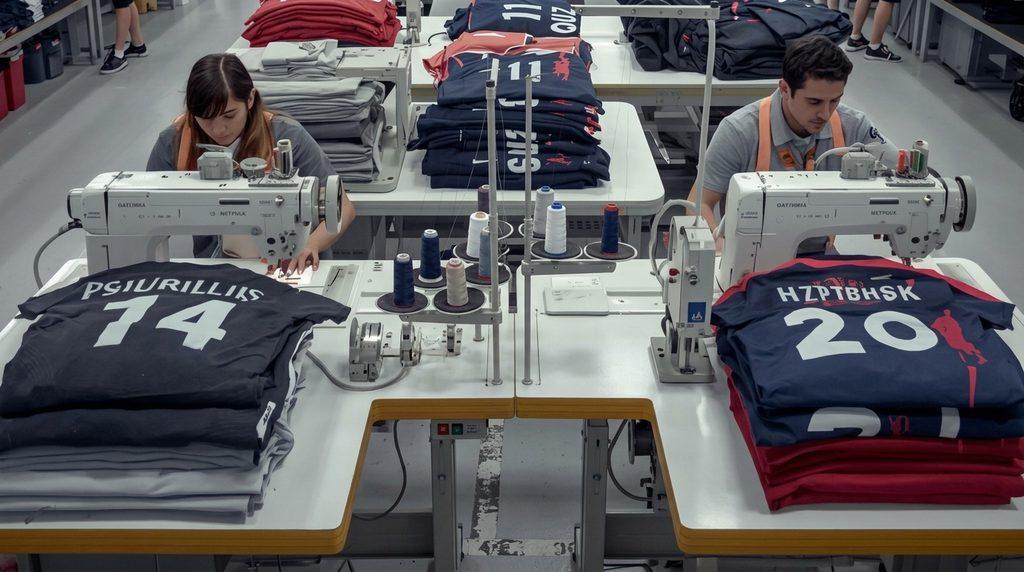
Full custom manufacturing is worth it when you want a specific design, a full colour range via sublimation, your own size chart, or private labelling — and especially when you’re ordering at scale or repeating the order each season. This is the route for a club standardising its whole squad in one design, a school matching its own house colours precisely, or a brand launching its own range under its own label.
Sizing, Fit and Quality Assurance
Fit is the biggest worry on a first custom order — you’re committing to a batch before seeing the finished garment, so it’s worth knowing what a well-run process looks like.
Reputable manufacturers grade separately for adult, women’s and youth fits, since these use different pattern blocks rather than a single size scaled up or down. Youth sizing should follow age-banded charts that match how school and club sections actually collect sizes. If you’re replacing kit from another supplier, a good manufacturer can pattern-match against a garment you already own rather than starting from a generic chart.
A digital mockup lets you check design and colours before production, and a physical sample (usually at extra cost, sometimes credited against the bulk order) lets you check fit before committing to the full run. Ask what happens if something still arrives wrong — a genuine quality guarantee should cover manufacturing defects with a free remake, distinct from a size the buyer chose incorrectly against the agreed chart.
How to Place an Order?
- Send Your Enquiry: Share your garment list, quantities, size breakdown (if known), logo or crest, colours and delivery details. Most suppliers respond with a quote within a day or two.
- Review the Digital Mockup: A proof showing your design on the actual garment usually comes back with 24-48 hours. Check colours, placement and text carefully, and ask for revisions before approving.
- Order a Physical Sample (Optional): Typically 5-7 days plus courier time. Worth doing on a first order or a new design, especially if fit or fabric feel matters.
- Bulk Production Begins: Once artwork and sizes are signed off, expect roughly 15-25 business days for a standard run, or a shorter express timeline at extra cost if you’re working to a deadline.
- Delivery: Courier shipping typically takes 5-10 days; sea freight for larger bulk orders runs 3-6 weeks.
Plan backwards from your deadline — for a September season start, aim to have artwork approved by early July.
Delivery & Payment Logistics for UK Buyers
Most overseas manufacturers ship to the UK via DHL, FedEx or UPS, with tracked delivery typically taking 5–10 days door to door. Larger bulk orders can go by sea freight instead, which is cheaper per unit but takes 3–6 weeks and is usually released to a forwarder at the UK port.
Payment is normally handled by international bank transfer (SWIFT) or a money transfer service such as Wise, Remitly or Xoom. Terms — deposit versus full payment, and when each is due — should be confirmed in writing alongside your quotation before production starts, so there’s no ambiguity on either side.
In the End
Custom sportswear doesn’t need to be complicated once you know which route fits your order — a local printer for a quick small run, a stock catalogue for speed and convenience, or full custom manufacturing when design control, private labelling or scale matter. Whichever you choose, the same checks apply: confirm fit before committing to a bulk order, get duty and VAT clarified upfront, and make sure there’s a real quality guarantee behind the price.
If you’re ready to move forward, start with a garment list, your sizes and your design — most suppliers can turn that into a quote and mockup within a day or two.
Frequently Asked Questions
If it’s manufactured in a country with UK trade preferences — Pakistan included, under DCTS Enhanced Preferences — apparel typically enters the UK duty-free. VAT still applies, but a good supplier builds this into your delivered price so there’s nothing to pay on arrival. Confirm the current rate with HMRC or your customs broker, as tariff schedules can change.
It varies by supplier, but 20–25 pieces per design is a common minimum for full custom manufacturing. Mixed sizes usually count within one design, so a squad of 20 across five sizes is still a single order. Some suppliers will go lower for small clubs on request.
Budget 15–25 business days for production after you approve the design, plus 5–10 days for courier delivery — so four to seven weeks in total from sign-off to arrival. Express production (7–12 days) is often available at extra cost for tight deadlines.
Yes. A single design can include a full size run — adult, women’s and youth blocks — as long as the total quantity meets the minimum order. This is standard for clubs and schools collecting sizes across a squad or year group.
Report it with photos and your order reference as soon as possible, usually within 7 days of delivery. A genuine manufacturing defect should be remade free of charge under the supplier’s quality guarantee. A size chosen incorrectly by the buyer against the agreed chart isn’t normally covered.
It depends on the garment and design. Embroidery suits crests and logos on lower-volume items like polos and hoodies, giving a raised, durable finish. Sublimation suits full-colour, all-over designs — match kit with names, numbers and sponsors — and works better across large printed areas than embroidery can.